Cisneros is not the story of one family but of many. Because the surname began as the name of a town, unrelated households adopted it independently over the centuries, and the men who carry it descend from several different paternal lines. Y-DNA testing, which follows the Y chromosome passed almost unchanged from father to son, lets us see those lines directly. Through the official Cisneros Surname Project at FamilyTreeDNA, results from Cisneros men around the world are compared and placed on the human paternal tree. So far they sort into three well-defined lineages of roughly equal size, along with a handful of results still searching for their match.
How Y-DNA differs from a regular DNA test
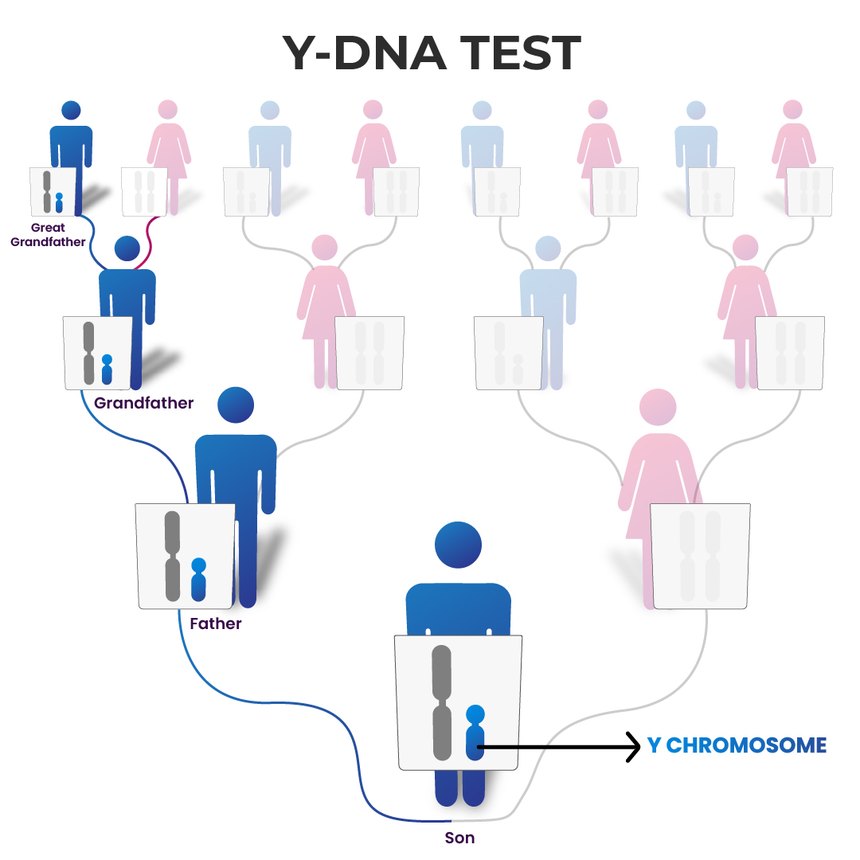
Y-DNA testing looks at just one thing: the Y chromosome, which a father passes to his son almost unchanged, generation after generation. Because it barely changes, it works like a surname written into the body, following the very same father-to-son path that the Cisneros name itself travels. That makes it an ideal tool for tracing where Cisneros families share an origin and for telling apart the distinct branches of the surname.
This is not the kind of test most companies sell. The popular kits from sites such as AncestryDNA and 23andMe are autosomal tests, often shortened to atDNA. An autosomal test samples a little DNA from every branch of your family, which is wonderful for finding recent cousins and for ethnicity estimates. But that signal fades fast: you inherit about half of each parent’s DNA, a quarter of each grandparent’s, and so on, so beyond roughly five generations there is usually too little left from any one ancestor to follow. An autosomal test simply cannot tell you whether two Cisneros men share a forefather four or five centuries back.
Y-DNA does not get diluted that way. Because it travels down a single line and changes so slowly, it stays readable across dozens of generations, even thousands of years, which is exactly the depth a surname study needs. One catch: only men carry a Y chromosome, so only men can take a Y-DNA test. A woman researching her Cisneros paternal line asks a father, brother, paternal uncle, or male cousin to test on the line’s behalf.
First, what is a haplogroup?
Every man inherits his Y chromosome from his father, who inherited it from his father, back through countless generations. Once in a great while a small, harmless change appears and is passed down to all of that man’s descendants. A haplogroup is simply a branch of the human family tree defined by one of those shared changes. Trace a haplogroup back far enough and it points to a particular corner of the ancient world, which is why two Cisneros men in different countries can learn, from their haplogroups alone, whether they share a forefather and where that forefather’s deep ancestry began.
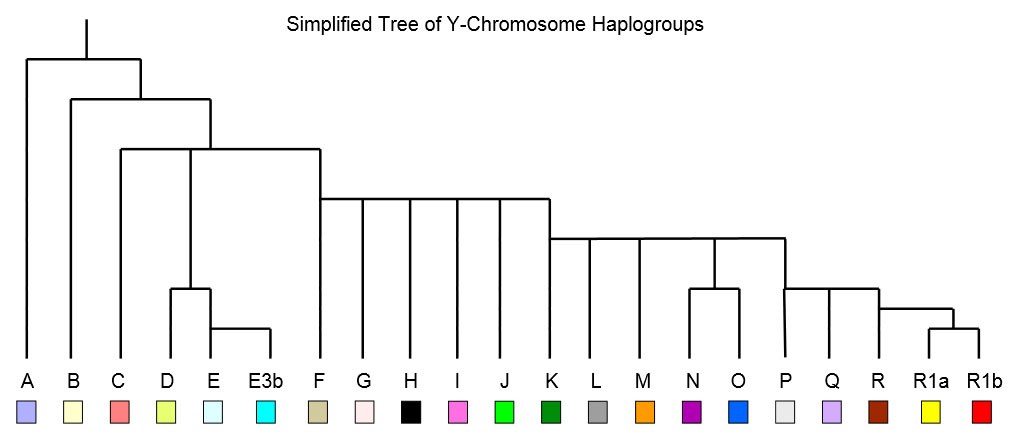
Reading the tree is simpler than it looks. The single line at the very top stands for the shared forefather of every man living today. Each place the tree splits marks the moment one of those small, permanent changes appeared, starting a new branch that all of that man’s descendants would carry. The lettered labels along the bottom, A through R and their sub-branches, are the haplogroups, and the colored squares are just a key to tell them apart. Branches that split low down, far from the top, parted ways in the deep past, tens of thousands of years ago, while branches bunched close together, like R1a and R1b, separated much more recently and are closely related.
So the closer two men’s branches sit, the more recently they shared a forefather; the nearer their split is to the root, the more ancient and distant the connection. This is the heart of the study. The Cisneros men tested so far do not all land on the same branch. Their three established lineages sit on different major limbs of this tree, which is direct evidence that the surname was taken up independently by unrelated families rather than handed down from a single ancestor.
There is one more thing the tree makes clear, and it matters. Every split on it happened in deep prehistory, thousands of years ago, long before surnames existed. Hereditary family names only came into common use in Spain in the Middle Ages, just a few centuries back. So when two Cisneros men sit on different branches, their paternal lines had already parted ways ages before anyone was ever called Cisneros. The forefather where their branches finally meet lived in a world with no surnames at all, and was certainly no Cisneros. Each line took up the name later and on its own, because Cisneros was a place that many families could be named for. That is exactly why men who share the surname today can descend from completely unrelated ancient lineages: the name is far younger than the branches it now rides on.
How haplogroups map the ancient world
Those same branches also trace humanity’s long journey across the globe. As small groups moved out of Africa and spread into the Near East, Europe, Asia, and eventually the Americas over tens of thousands of years, each carried its own slowly-changing Y chromosome, and each region came to be linked with particular haplogroups. The map below follows those ancient paths.
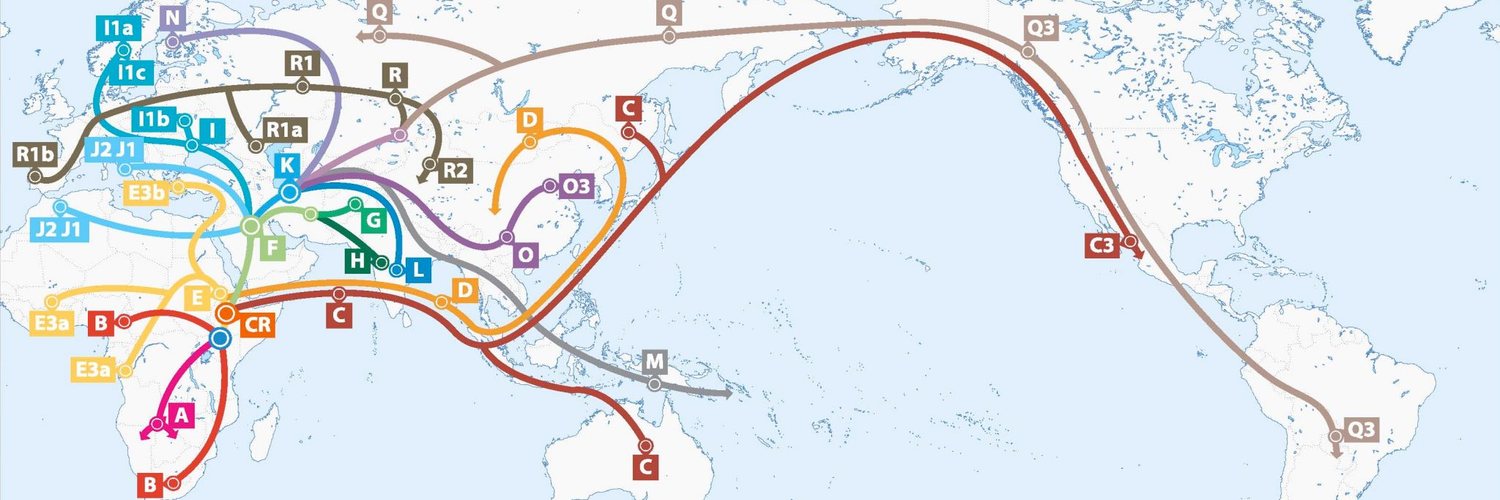
This is why a man’s haplogroup hints at where his deep paternal ancestry began. The three Cisneros lineages below sit on different branches of this tree, with roots reaching toward the Mediterranean and North Africa, the Fertile Crescent, and Ice-Age Europe.
The Cisneros paternal lineages
The project has sorted tested Cisneros men into distinct paternal lineages, each named for the haplogroup that defines it, and each with a strikingly different deep history. The full list, with the earliest documented ancestor of every line, is kept on one page so it stays current: Lineages & Earliest Ancestors.
What the results tell us
The clearest finding is that the Cisneros surname has several unrelated origins. Y-DNA from documented male-line Cisneros families falls into distinct haplogroups, which confirms that the name binds people through history and shared place rather than through a single common ancestor. For anyone researching their line, this is exactly why DNA is so powerful. It can reveal whether two Cisneros families share a forefather or simply inherited the same town’s name.
Read together, the lineages also tell the story of Iberia itself. A native European line older than agriculture (I-M223), a Near Eastern line carried west by the first farmers and traders (J-M172), and a Mediterranean line woven through Sephardic history (E-V22) all meet under a single Castilian surname, then travel onward to Mexico and the American Southwest. Few surnames capture the layered history of Spain and its reach into the Americas so vividly.
What your Y-DNA could reveal
If you carry the Cisneros name on your direct paternal line, a Y-DNA test can place your branch on this tree. It can tell you which of the established lineages you belong to, connect you with genetic cousins you never knew you had, and trace your paternal origin back across centuries and oceans. For some families the result has confirmed a Spanish homeland; for others, a deeper Sephardic or Mediterranean past. The only way to learn which story is yours is to test.
How to take part
1. Test your Y-DNA at FamilyTreeDNA. The Big Y-700 test gives the fullest picture and is what defines the lineages above, though a 37 or 111-marker test is a perfectly good place to start.
2. Join the Cisneros Surname Project. Joining places your results alongside other Cisneros men so they can be compared and clustered. Every spelling is welcome, including Cisneros, Sisneros, Zisneros, and de Cisneros.
3. Share your earliest known ancestor. Adding the oldest documented name, date, and place on your paternal line lets the project tie genetic clusters to real family history.
A note for Cisneros women: because the Y chromosome passes only from father to son, women do not carry it themselves, but they can absolutely take part. Asking a Cisneros father, brother, paternal uncle, cousin, or grandfather to test brings that shared paternal line into the study and answers the same questions about your own family.
Join the Cisneros Surname Project
Add your paternal line to the study, connect with genetic cousins across centuries and continents, and help complete the picture of where the Cisneros name truly comes from.
Visit the Cisneros Project at FamilyTreeDNACost a barrier? The project may sponsor a basic Y-DNA test for eligible applicants. See the earliest known ancestor of every tested line to check whether your branch is already represented. Apply for a sponsored test →