The arrival of my Cisneros paternal line in the Americas was not a single voyage from Spain to Mexico. It was a staged migration shaped by the death of a prominent father, a divided Sevillian household, an unresolved inheritance, the loss of one brother in Havana, and the military career of another in a Mexican republic entering one of the most turbulent periods of its history.
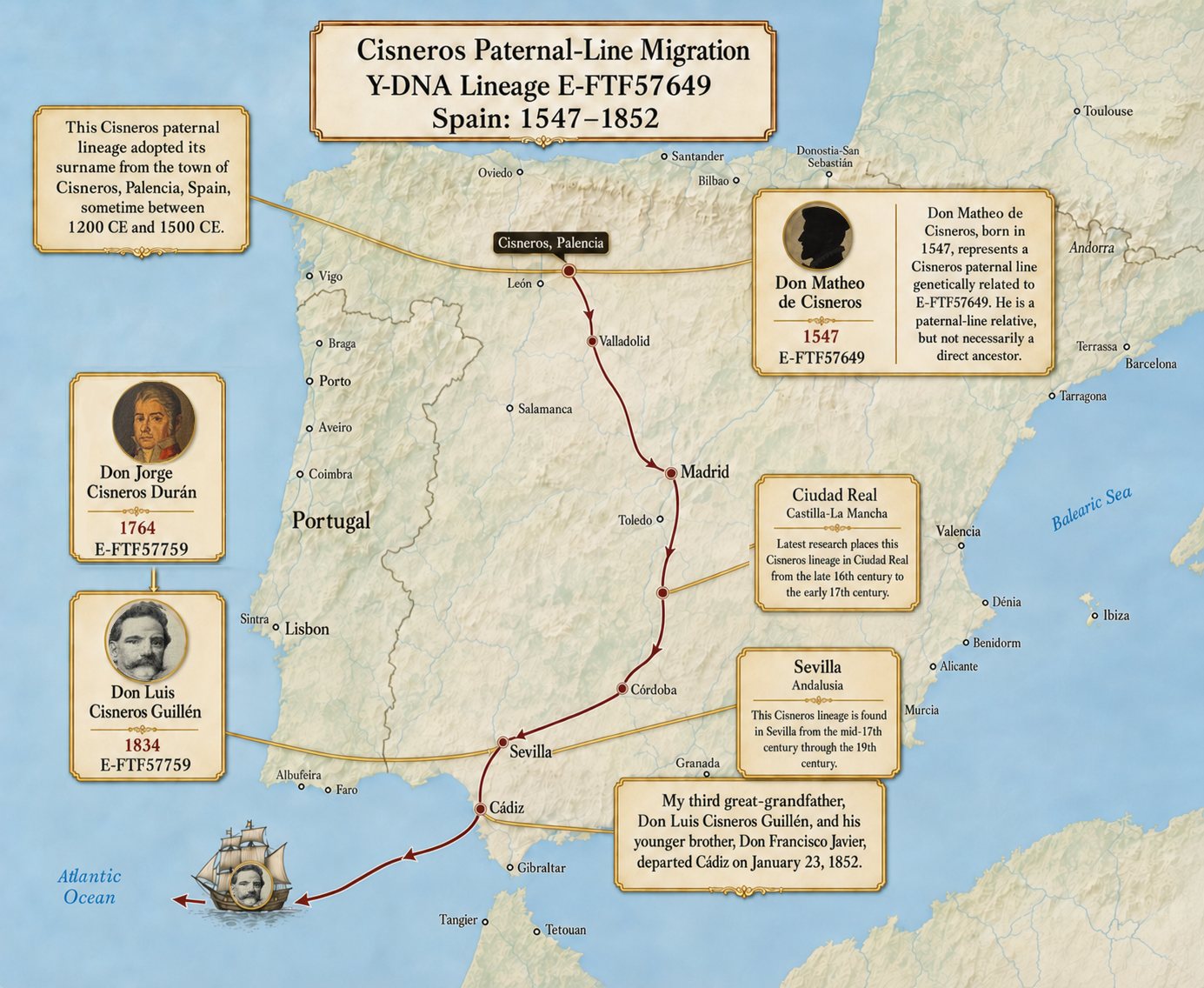
At the center of it stands my third great-grandfather, Luis Gonzaga Cisneros y Guillén, born in Seville on February 20, 1834. In January 1852, still seventeen, he left Cádiz aboard the Spanish sailing vessel Paquete Gaditano with his younger brother, Francisco Javier Cisneros y Guillén. Their first destination was Havana. Francisco Javier would die there the following year.
A line on a map makes the journey look orderly. The surviving records tell a more complicated story, and this article follows them document by document, separating what is proven from what is merely likely.
Don Jorge de Cisneros y Durán Sotomayor
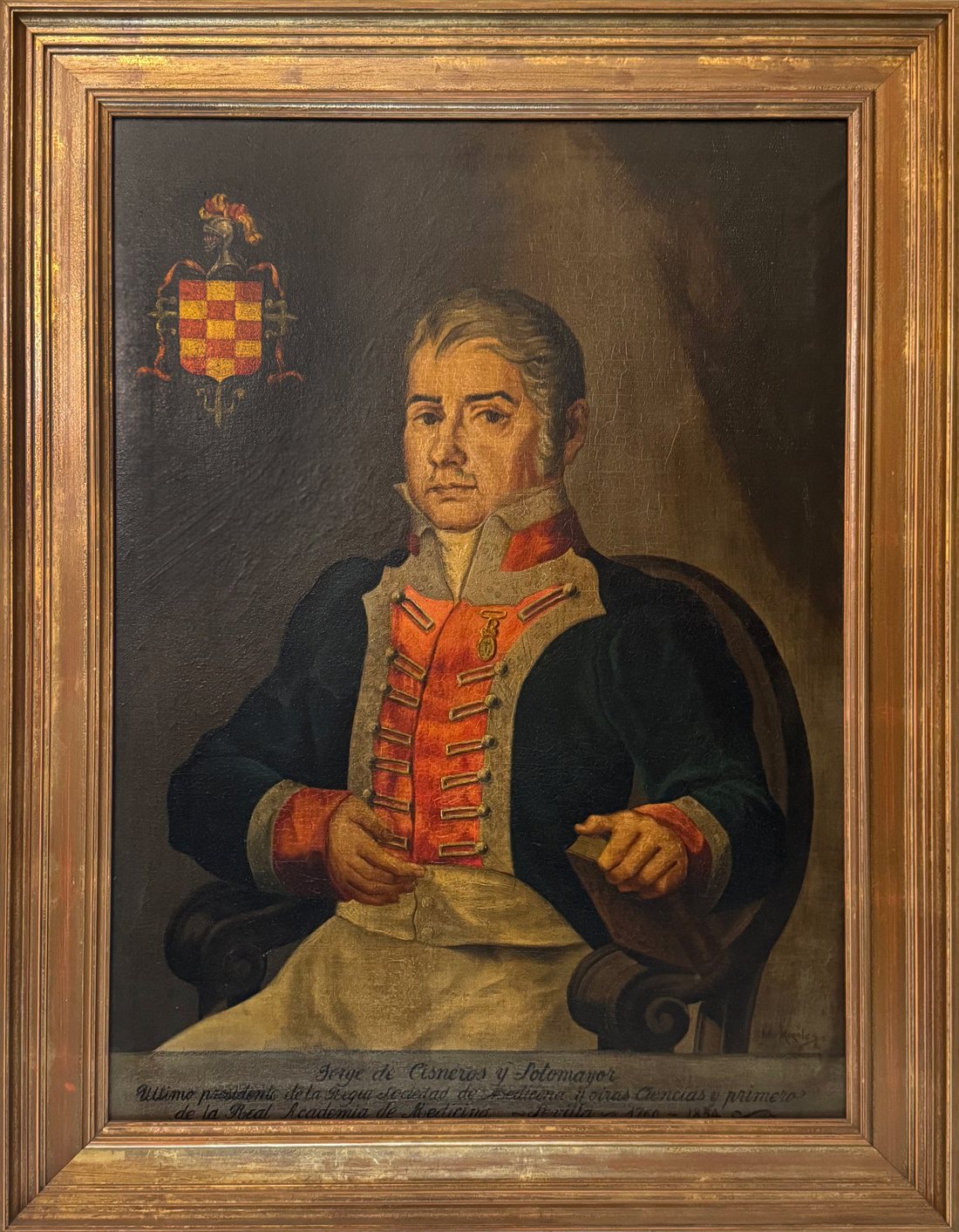
This migration begins not with a ship but with the father whose death rearranged the family.
Don Jorge de Cisneros y Durán Sotomayor was born in Seville in 1764, into the educated professional world of late eighteenth-century Spain, where medicine, military administration, and royal learned societies constantly overlapped. His surviving portrait shows him seated in formal dress beneath a painted coat of arms, and the inscription beneath identifies him as the last president of the Regia Sociedad de Medicina y otras Ciencias de Sevilla and the first president of the Real Academia de Medicina y Cirugía de Sevilla.
That is not two unrelated honors. It marks a hinge in Spanish institutional history, and the institution in question is no minor one. It began in 1693 as a private circle of Sevillian physicians, the Veneranda Tertulia Médica Hispalense, and was chartered by Felipe V on October 1, 1701 as the Regia Sociedad de Medicina y demás Ciencias de Sevilla: the first medical academy in Spain, and by its own reckoning the oldest in the world. On August 28, 1830, a royal order of Fernando VII created the district royal academies and transformed the Regia Sociedad into the Real Academia de Medicina y Cirugía de Sevilla.
Don Jorge, in other words, presided over that institution at the precise moment it changed its name and its legal character. He closed one three-hundred-year chapter and opened the next. His career was also tied to military medicine, which fits both the uniform-like dress of the portrait and the period's close weave of medicine and military administration.
The portrait communicates authority, continuity, and public accomplishment. His private household was considerably less tidy.
Four marriages and a divided family
Don Jorge married four times.
Those marriages produced a household of children by different mothers, born at different stages of his life, occupying competing positions within the family. The age gaps between them, and the legal interests of their separate maternal branches, would matter enormously once he died.
His fourth and final wife was Doña María Antonia Guillén y Montero. Their children included Jorge, Luis Gonzaga, María de la Concepción, and Francisco Javier Cisneros y Guillén. The two brothers who would cross the Atlantic therefore belonged to the youngest group in the house, with older half-siblings from earlier marriages who held a different generational and legal standing in the estate.
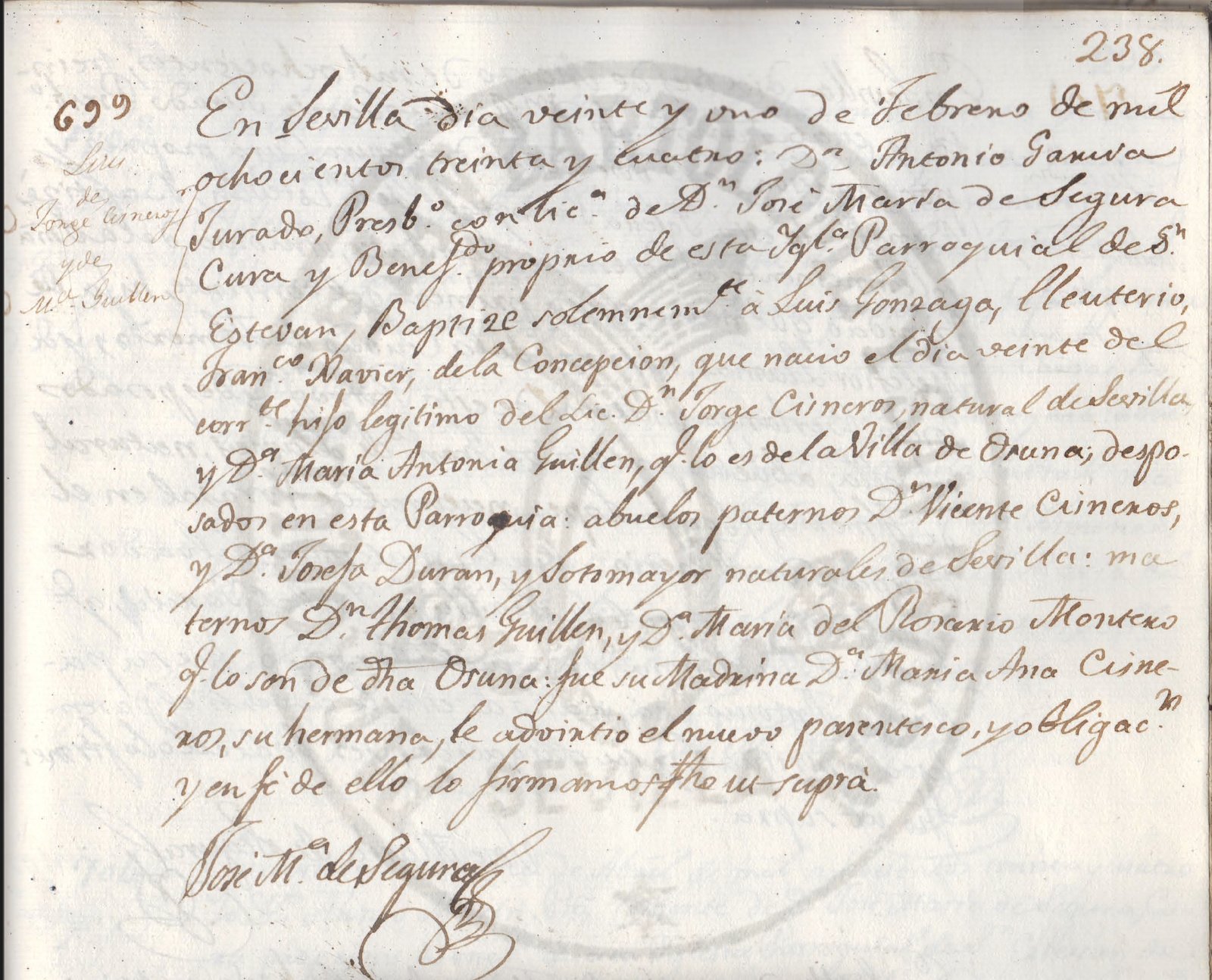
Luis's own baptism survives, and it is a quiet genealogical treasure. On February 21, 1834, at the parish of San Esteban in Seville, a boy born the previous day was christened Luis Gonzaga, Eleuterio, Francisco Javier, de la Concepción, a string of names that already echoes two of his siblings. The entry styles his father Licenciado, notes that his parents had married in that same parish, records his mother as a native of the villa de Osuna, and then reaches back one generation further than any other document in this file. The paternal grandparents were Vicente Cisneros and Josefa Durán y Sotomayor, both of Seville; the maternal grandparents, Tomás Guillén and María del Rosario Montero, both of Osuna.
Those four names explain the family's compound surnames at a stroke. Don Jorge carried Durán Sotomayor because it was his mother's name; María Antonia carried Guillén y Montero from her parents. The record also leaves one loose thread: the godmother was María Ana Cisneros, noted simply as the child's sister, a sibling who has not yet appeared elsewhere in this reconstruction and who most likely belonged to one of Don Jorge's earlier marriages.
Don Jorge died in 1841, when Luis was seven years old. His death did not quietly close the household. It opened a probate process surviving in a file of more than one hundred pages, covering the administration of his estate and the competing claims of heirs from different marriages. The material appears to document real friction, particularly between the branch descended from his first marriage and the young children of his fourth.
Did the probate conflict push them out?
Eleven years separate Don Jorge's death in 1841 from the brothers' departure in 1852. Across that interval Luis grew from a boy into a young man while his widowed mother and the various heirs worked through the consequences of the estate. Property, guardianship, inheritance rights, household authority, and obligations owed to children of different marriages may all have been contested.
It is entirely plausible that this narrowed the prospects of the younger children, or simply made Seville less appealing, and that Cuba looked like somewhere family connections, military opportunity, or commerce could offer a way past the dispute. But plausible is not proven, and the distinction matters.
Don Jorge married four times, left children from several marriages, and his death in 1841 generated an extensive probate proceeding.
The probate involved tension between branches of the family, including descendants of the first and fourth marriages.
That the dispute contributed to Luis and Francisco Javier's decision to leave Seville. Unless the file contains a statement tying the two together, the connection remains an inference.
Historical motive rarely survives as a convenient declaration. It usually has to be reconstructed from circumstance: a dead father, a widowed mother, contested property, older half-siblings, thin prospects, and two young men preparing to leave the country.
From Seville to Cádiz
Although the family was Sevillian, the Atlantic voyage began at Cádiz, and that detail carries real history.
Seville had once monopolized Spain's imperial commerce through the Casa de la Contratación, founded there in 1503. But the Guadalquivir imposed hard limits on increasingly large oceangoing ships, and in 1717 the crown moved the House of Trade downriver to Cádiz, on the open Atlantic. By the nineteenth century Cádiz was the principal Spanish gateway to Havana, Veracruz, and the wider Atlantic world. Even after Mexican independence, traffic continued between Cádiz and Cuba, which stayed under Spanish rule until 1898.
No record has yet surfaced showing when the brothers left Seville for Cádiz, which road they took, where they lodged, or who arranged their passage. What survives is the ship.
The Paquete Gaditano
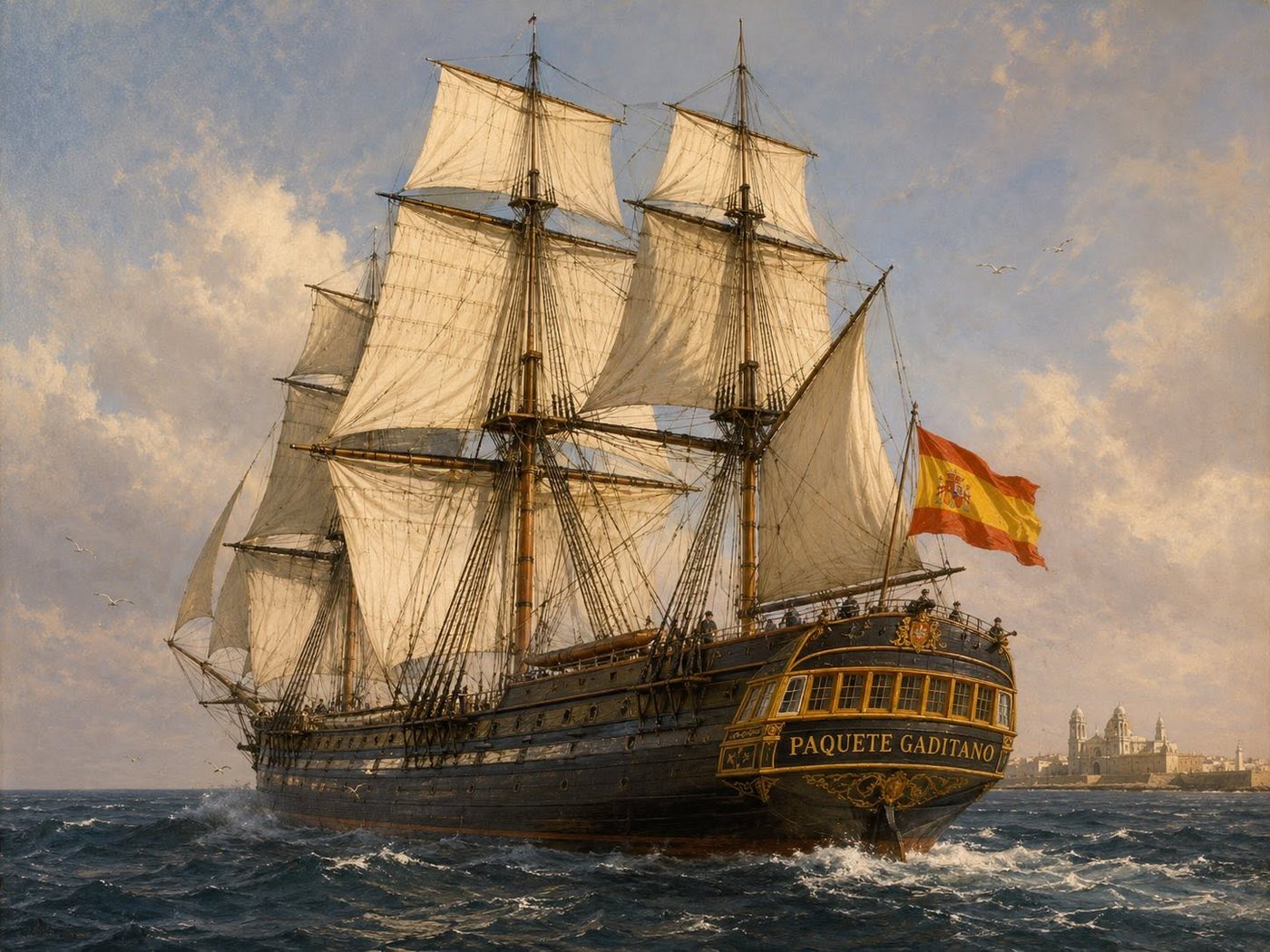
The Havana papers do not even agree on what kind of ship she was: the Gaceta's mercantile column abbreviates her as a Spanish frigate, while the Diario de la Marina calls her a corvette. Nineteenth-century maritime terminology varied by local usage, rig, and administrative convention, so the safest description is simply the Spanish sailing vessel Paquete Gaditano.
Its name tells you its trade. Paquete was the common term for a vessel carrying passengers, mail, and merchandise on an established route, and gaditano means “of Cádiz”.
The crossing took twenty-nine days. Not unusually long for the period, but long enough to expose passengers to the ordinary hazards of Atlantic travel: crowded quarters, limited fresh water, poor sanitation, seasickness, storms, and the constant possibility of illness aboard.
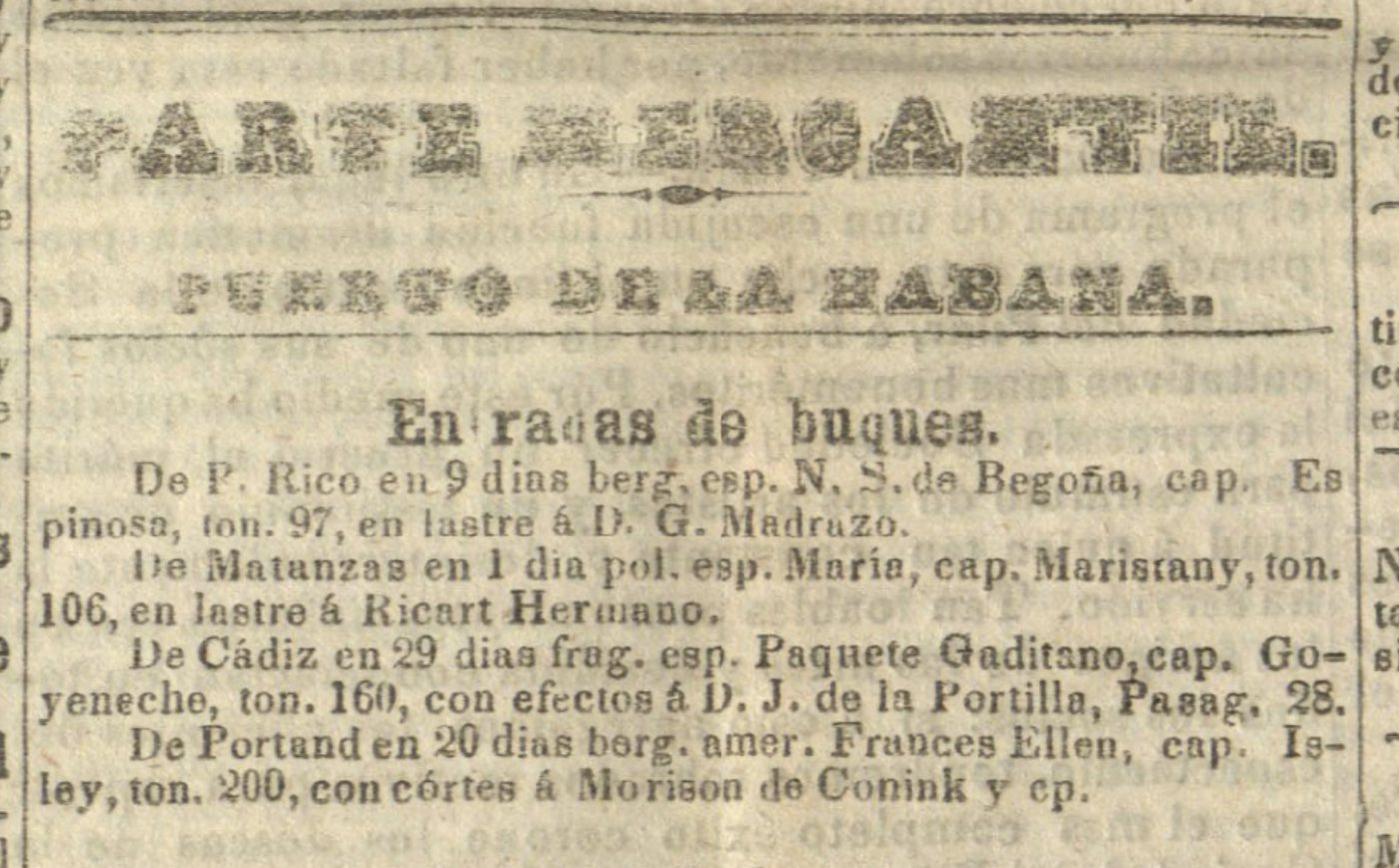
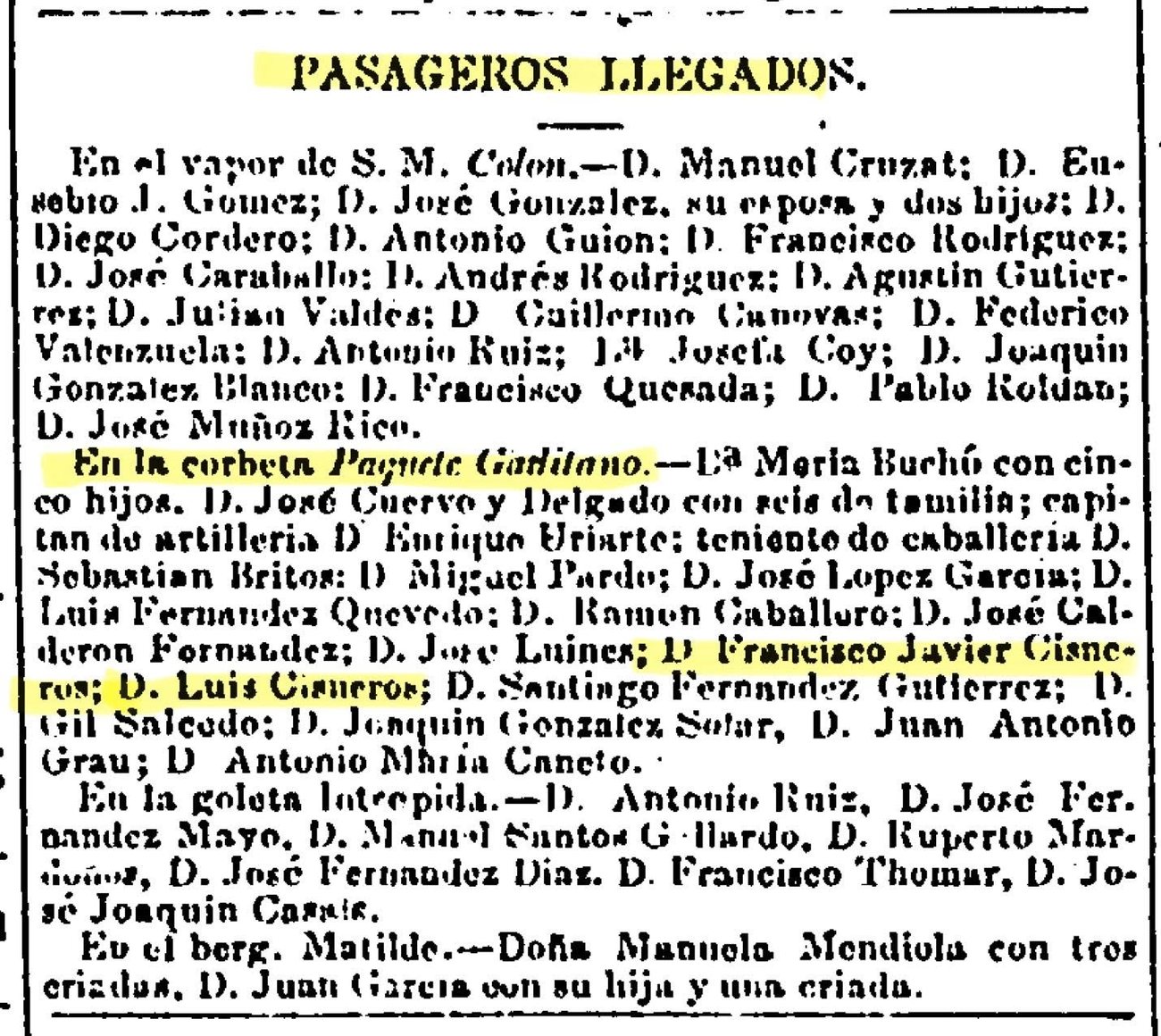
The Parte Mercantil column of La Gaceta de La Habana recorded the arrival of the Paquete Gaditano from Cádiz after twenty-nine days at sea. It names the master, Goyeneche, gives the tonnage as 160, notes the cargo consigned to D. J. de la Portilla, and counts twenty-eight passengers aboard. The passenger column of the Diario de la Marina names two of them:
D. Luis Cisneros Diario de la Marina, Havana, February 22, 1852
The arrival was reported in the Gaceta of February 21, 1852, with the passenger list printed in the Diario de la Marina the following day. Counting back twenty-nine days places the departure from Cádiz on or about January 23, 1852. That departure date is a reconstruction from the arrival notice, not a date stated in the record itself.
His baptismal record says Luis was born on February 20, 1834. If the recorded dates are right, he stepped ashore in Havana at eighteen years old, within a day of his birthday, perhaps on the day itself, since port columns often carried the previous day's arrivals.
Havana: destination, crossroads, colonial capital
The Havana the brothers entered in 1852 was among the most important ports in the Spanish Atlantic. Cuba remained under Spanish government, and the city served at once as fortified naval center, commercial port, administrative capital, and gathering point for migrants moving between Europe, the Caribbean, Mexico, and the United States.
Its harbor took in warships, merchantmen, mail packets, coastal craft, and passenger vessels. Its streets held colonial officials, soldiers, sailors, merchants, artisans, enslaved laborers, free people of color, peninsular Spaniards, and travelers from across the Atlantic world.
Whether Havana was meant as a destination, an opportunity, or a waypoint, no surviving letter says. The documents establish only that Luis was connected with Havana from February 1852 until early February 1854, roughly twenty-three months. That does not prove he spent every day in the city. The most accurate formulation is that he spent nearly two years in Cuba, principally associated with Havana.
His brother would never leave the island.
The death of Francisco Javier
Francisco Javier died in the district of the Parroquia de Monserrate in Havana on September 9, 1853. He had left Cádiz at fourteen and was dead at fifteen, roughly eighteen months after stepping ashore in Cuba. The cause is unknown. We can only imagine what Luis must have felt, losing his younger brother so far from home.
The document that records that death was drawn up neither in Havana nor in Mexico, but on a Mediterranean island. On February 26, 1859, before a notary at Ciudadela de Menorca, Doña María Antonia Guillén, widow of Don Jorge Cisneros, appears as a native of Osuna in the province of Seville and by then a resident of Ciudadela. She acts in three capacities at once: for herself, as heir of her late son Francisco Javier, and as guardian of her younger son Luis. The instrument grants a broad power of attorney to her absent son Don Jorge Cisneros y Guillén to collect monies, credits, interest, pensions and other property on her behalf.
The record quietly confirms something the 1834 baptism had already said: María Antonia came from Osuna. Twenty-five years after her husband's death, she was still working through what his estate owed.
That death changed the shape of the journey. Two brothers had left Spain together; only one would continue to Mexico. About five months later, Luis boarded a ship for Veracruz. Whether his brother's death prompted that departure the records do not say. Chronology alone cannot establish motive. What can be said is that by early 1854 the family's Cuban chapter had split cleanly in two: Francisco Javier was dead, and Luis was leaving.
From Havana to Veracruz aboard the Martín
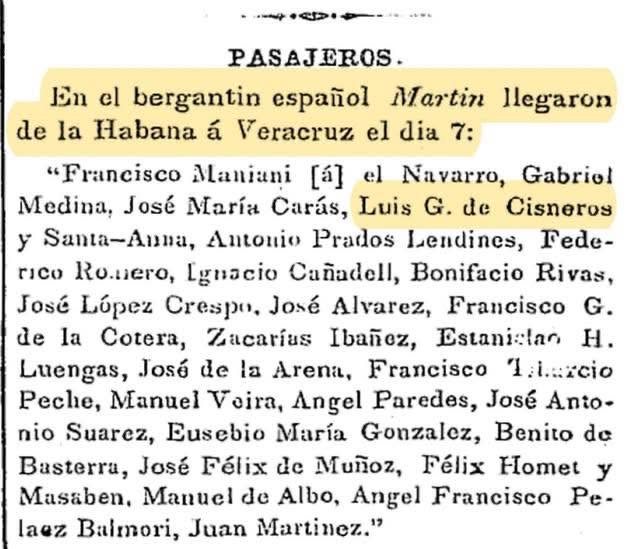
In early February 1854, Luis left Havana aboard the Spanish brig Martín. A passenger notice in the Mexico City newspaper El Universal reported that the vessel reached Veracruz from Havana on February 7, 1854, and among the passengers appears Luis G. de Cisneros.
The name, the initials, the route, and the chronology all correspond with Luis Gonzaga Cisneros y Guillén.
One honest complication deserves to stay visible. The printed line appears to continue with the words “y Santa-Anna”. It is not yet certain whether that formed part of the passenger's recorded name, belonged to the next passenger, or resulted from punctuation or typesetting. The ambiguity does not overturn the identification, particularly since another record places Luis Gonzaga de Cisneros in Mexico City three weeks later, but it should not be quietly edited away.
Veracruz, and arrival in Mexico City
Veracruz was Mexico's principal Atlantic port and the traditional maritime entrance to the central plateau. Travelers continued inland toward Jalapa, Puebla, and Mexico City, crossing sharply different elevations and climates from the humid Gulf coast up to the high valley.
Luis arrived in a port marked by commerce and war. Veracruz had been bombarded by French forces in 1838 and taken by the United States in 1847. In 1854 the memory and the physical damage were both recent. The railway linking Veracruz directly to Mexico City would not be finished until 1873, so he traveled inland by the existing road and stagecoach network, possibly combining carriage with horseback.
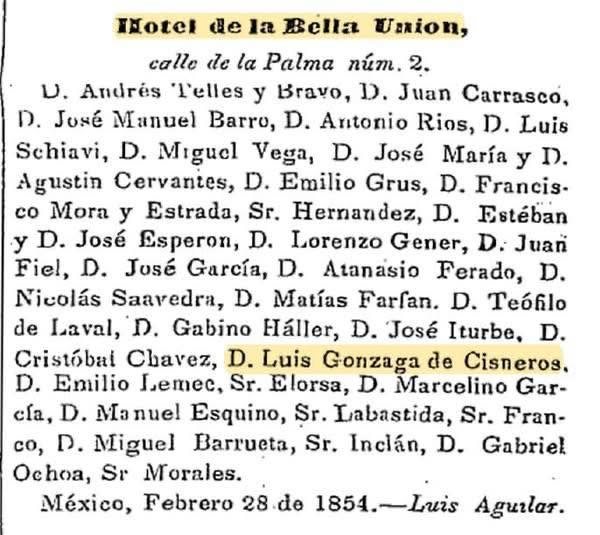
The itinerary is unknown. The arrival is not. A hotel registry published in El Universal listed Don Luis Gonzaga de Cisneros among the guests of the Hotel de la Bella Unión on Calle de la Palma, dated February 28, 1854, twenty-one days after the Martín docked at Veracruz.
Nineteenth-century hotel lists worked as public registers of mobility, letting merchants, officials, creditors, and relatives learn who had entered the capital and where to find them. Luis was no longer simply somewhere in Mexico. He could be found at a named hotel, on a named street, on a specific day.
Arrival on the eve of revolution, and “español y militar”
He entered Mexico City at an extraordinary moment. Antonio López de Santa Anna had returned to power in 1853 and installed his final authoritarian government, and opposition was spreading through the south. On March 1, 1854, the day after that hotel registry was dated and the very day El Universal printed it, his opponents proclaimed the Plan of Ayutla.
The movement became a revolution that drove Santa Anna from power in 1855 and opened the way to the liberal Reform associated with Juan Álvarez, Ignacio Comonfort, Benito Juárez, and the Constitution of 1857. Luis did not arrive in a settled country. His first years in Mexico coincided with the Revolution of Ayutla, the fall of Santa Anna, the Reform laws, the Constitution of 1857, and ultimately the War of Reform.
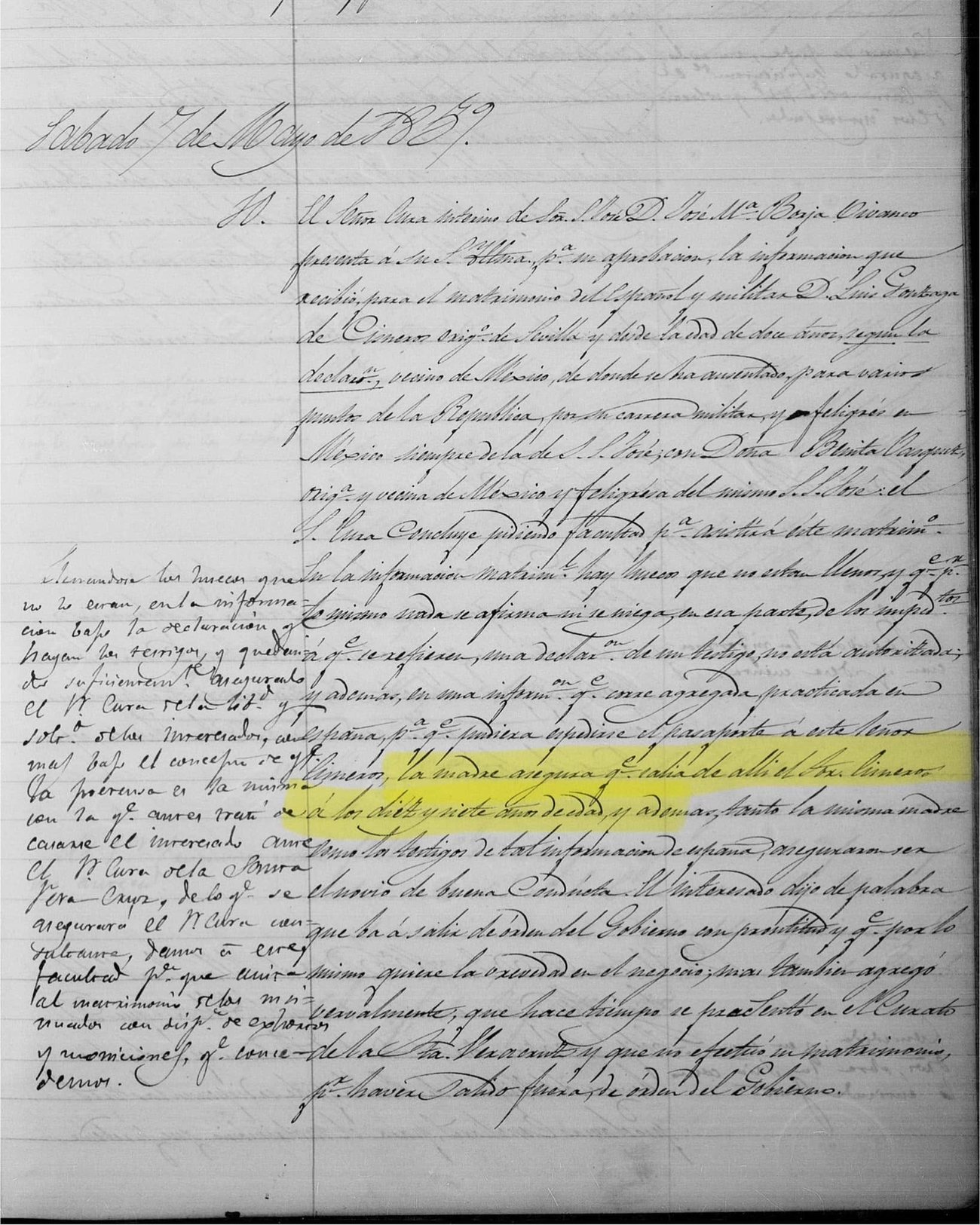
That context matters, because a later record identifies him as a military man. An ecclesiastical proceeding connected with his 1859 marriage describes him explicitly as “español y militar”, and explains that he had been absent from Mexico City in various parts of the Republic “por su carrera militar”.
This is the strongest direct evidence yet found about his occupation. A contemporary church authority recognized him as both Spanish and military, and recorded that his career had carried him across several parts of Mexico. The same file contains a small, humanizing detail: his mother's statement that he had left Spain at seventeen, which matches a January 1852 departure for a boy born in February 1834.
It does not, however, answer everything. The document gives no rank, no regiment or corps, no date of entry into service, no indication whether he served in the regular army or a militia, whether his service began in Cuba or Mexico, or which political faction he supported. Given the timing, his career almost certainly unfolded amid the Ayutla and Reform conflicts, but context alone cannot establish allegiance. Until a service record, muster roll, promotion, military court file, or pension application turns up, he should not be assigned to any army or camp.
Marriage, and a new Mexican branch
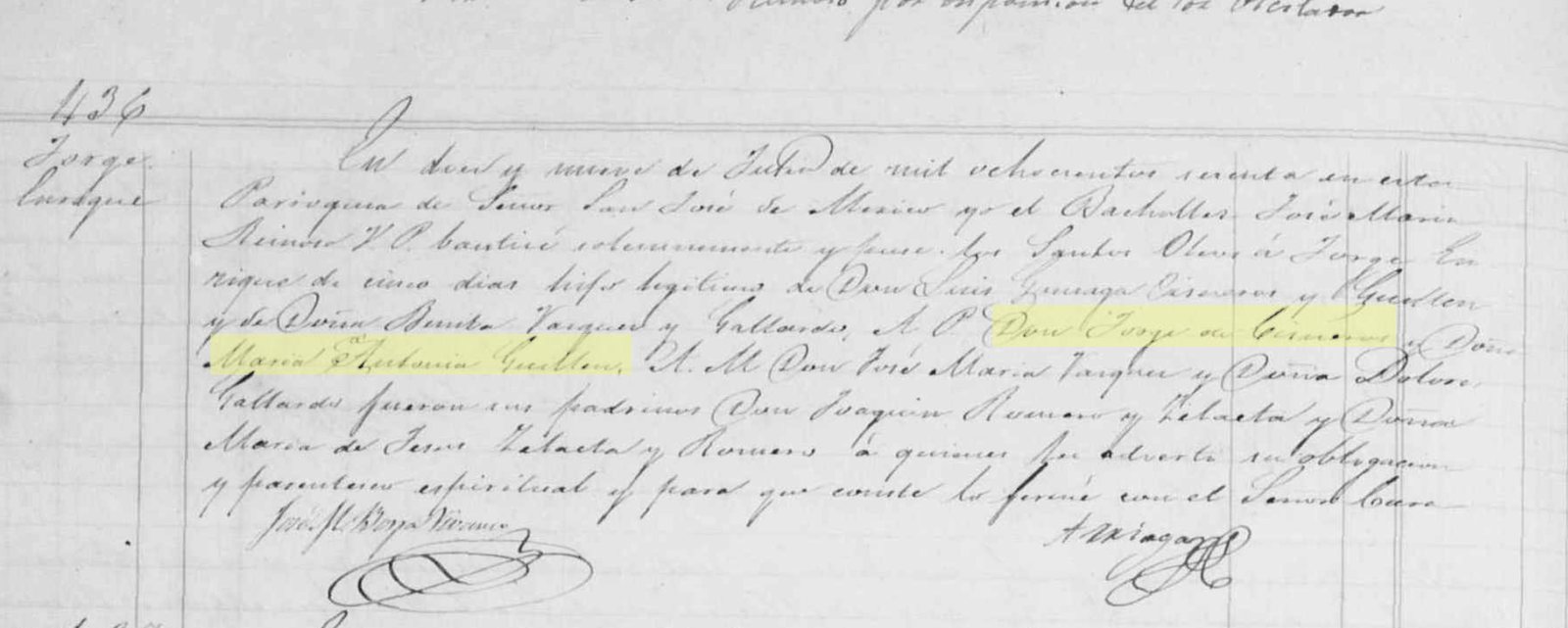
The proceedings concerned his marriage to Benita Vázquez, entered on May 7, 1859 in the marriage register of the Arquidiócesis de México, and that union marks the turn from migration to settlement. Luis had arrived as a young Spanish traveler. Marriage and a child made him the origin of a Cisneros branch rooted in Mexico City.
The 1860 baptismal record above is the single most eloquent document in this whole file. In four lines it gathers three generations and two continents: the newborn Jorge Enrique, his parents Luis Gonzaga and Benita, and, named as paternal grandparents, Don Jorge de Cisneros and María Antonia Guillén. A Sevillian household destroyed by a probate dispute reappears, intact on paper, in a Mexico City parish register nineteen years later.
By this point the family's business was being transacted in three widely separated places at once. In February 1859 his widowed mother was at Ciudadela de Menorca, settling the estate of one dead son and acting for another who was overseas. Three months later Luis was in Mexico City, presenting his marriage papers. A power of attorney executed in Mexico City in 1860 identifies him as Don Luis Gonzaga Cisneros y Guillén, a Spanish citizen from Seville, and grants authority to his full brother Don Jorge Cisneros y Guillén, the same brother their mother had empowered from Menorca the year before.
That instrument preserves both halves of his identity at once. He was still formally Sevillian and a Spanish citizen, but conducting legal business from Mexico City. The family had spread across Spain, Cuba, and Mexico without immediately severing its internal legal ties. This was not an abrupt break with the past. It was a gradual redistribution of a family across an ocean.
Enrique, Vicente Luis, and the ranks of Zapata
Luis and Benita's son, Enrique Cisneros Vázquez, was born in Mexico City in 1860. Luis died the following year, in 1861, at twenty-seven. Only seven years separated his arrival at Veracruz from his death. His son carried the line forward.
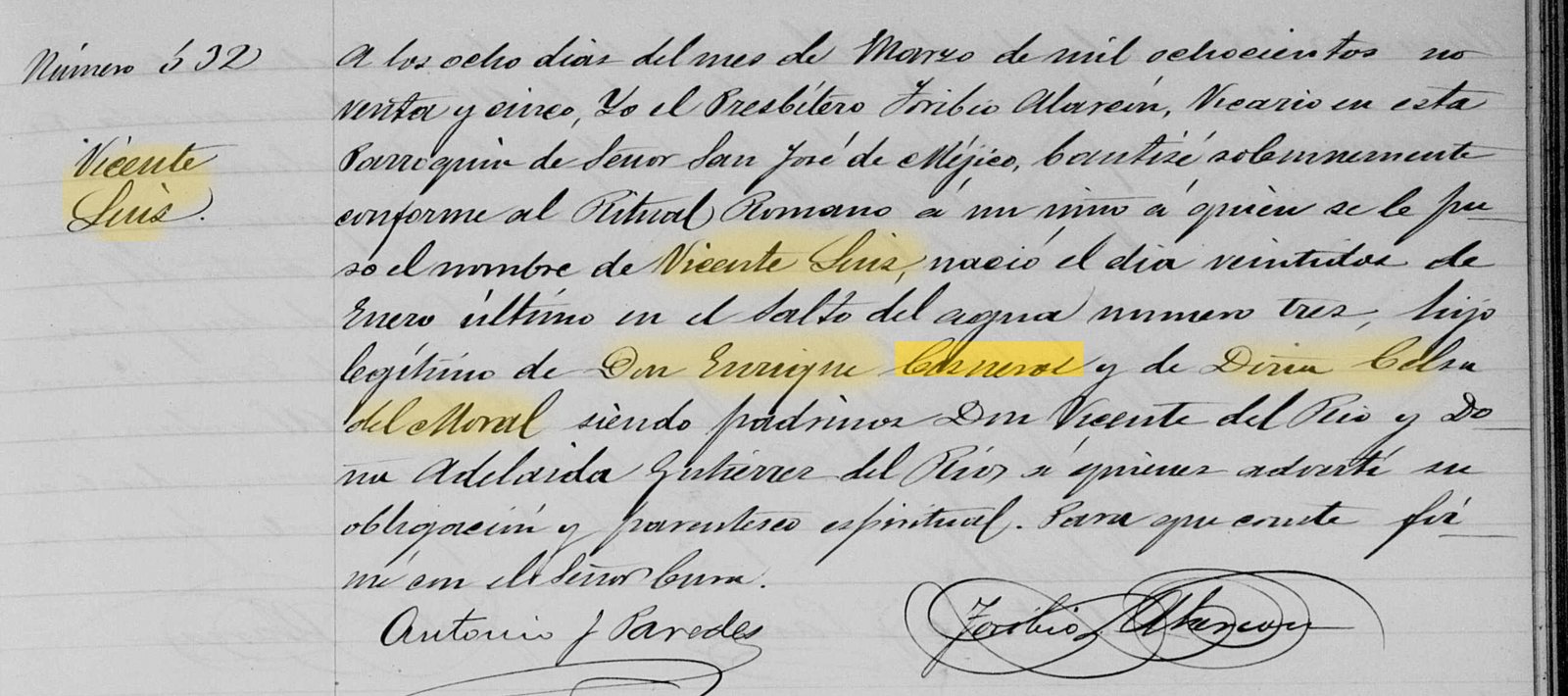
Enrique later married Celsa del Moral. They had twelve children in all; two died in infancy, and the rest lived out their lives between Mexico and the United States. On March 8, 1895 a parish record documented the baptism of one of them, Vicente Luis, born on January 22 of that year, known in the family as Luis Cisneros del Moral. By then the meaning of the family's presence in Mexico had changed: the migrant's grandson belonged to a Mexican-born lineage several generations deep.
Luis Cisneros del Moral later traveled north and entered the United States through Laredo, Texas, on August 30, 1916, in the middle of the Revolution's most violent years. His descendants established branches in Texas and later elsewhere, including Pennsylvania.
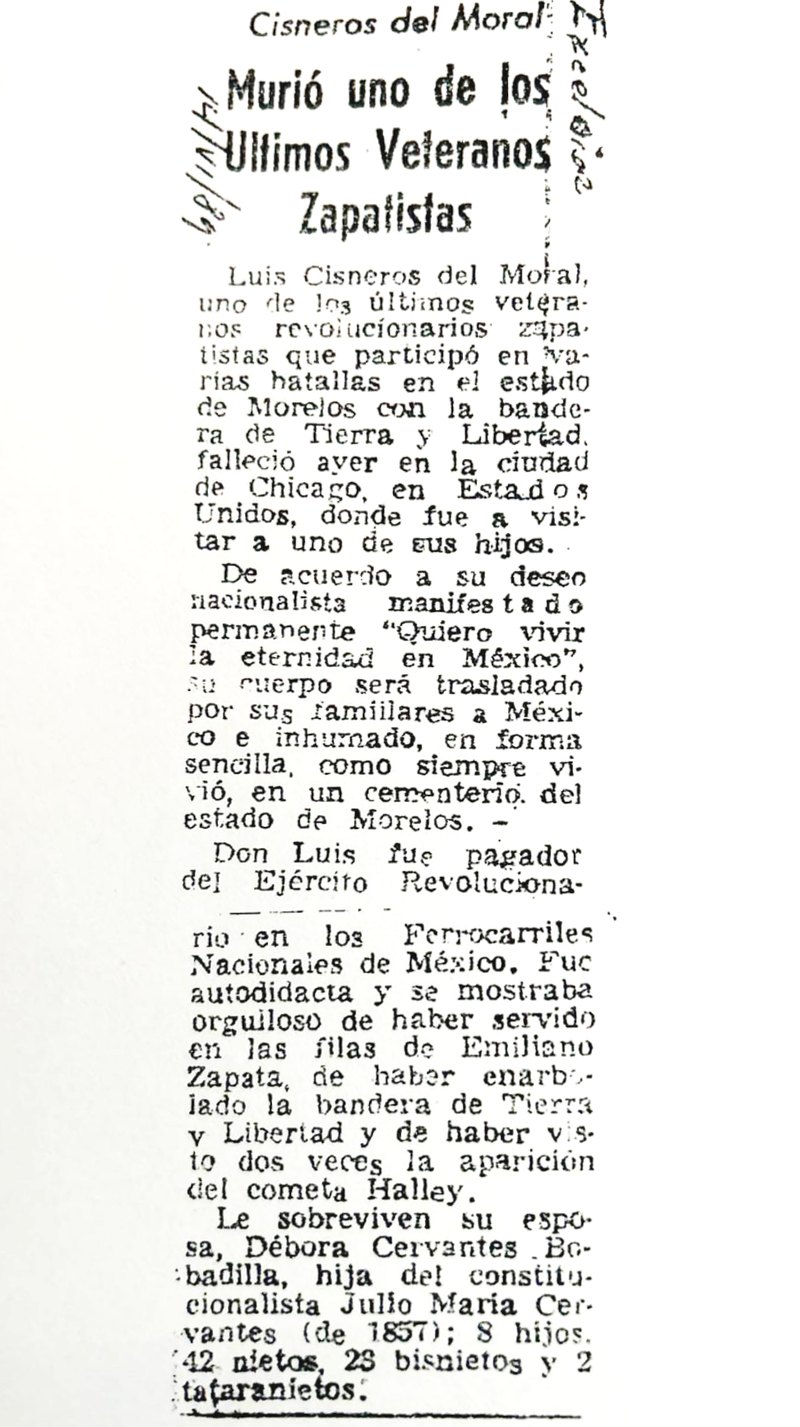
The quiet parish entry of 1895 gives no hint of the life it opened. When Luis Cisneros del Moral died, the Mexico City press remembered him under a remarkable headline: “Murió uno de los últimos veteranos zapatistas”, one of the last Zapatista veterans has died.
The obituary states that he fought in several battles in the state of Morelos under Emiliano Zapata's banner of “Tierra y Libertad”, Land and Liberty; that he served as a paymaster of the Revolutionary Army on the National Railways of Mexico, the circulatory system of that war; that he was self-taught; and that he stayed proud to the end of having served in Zapata's ranks, of having raised that banner, and of having watched Halley's comet pass twice.
That last detail deserves a pause. The comet's 1910 apparition hung over Mexico in the closing months of the Porfiriato, and many across the country read it as an omen of the upheaval that began that November. Luis saw it at fifteen. He saw it again in 1986, at ninety-one, three years before his death. One life held both passages of the comet, with the entire Revolution in between.
He died in Chicago, where he had gone to visit one of his sons. The obituary records the wish he repeated all his life, “Quiero vivir la eternidad en México”, I want to spend eternity in Mexico. His family carried his body home and buried him simply, as he had lived, in a cemetery in the state of Morelos, the same ground he had fought over seven decades earlier.
It also records his survivors: his wife, Débora Cervantes Bobadilla, a daughter of General Julio María Cervantes Aranda of Puebla, later governor of Querétaro and of Coahuila, and of Enriqueta Bobadilla of Chihuahua; together with eight children, forty-two grandchildren, twenty-eight great-grandchildren, and two great-great-grandchildren. Four of his sons served in the United States Armed Forces during the Second World War, and two came home with Purple Hearts. Cervantes is the second surname carried by the six sons on the map below.
The obituary gives no dates for his battles, so the chronology of his early manhood stays open. If his fighting preceded the Laredo crossing of August 1916, he was between sixteen and twenty-one; if any of it came after, he returned to a Morelos still at war. Either way, the arc across the generations is extraordinary: the grandson of a Sevillian recorded as “español y militar” in 1859 carried a Mexican revolutionary banner half a century later, and his own son, Enrique Cisneros Cervantes, born in 1924, jumped into the Second World War with the U.S. 504th Parachute Infantry Regiment, the Purple Heart story told in the article that began this project. Military service runs down this line like a watermark: the Reforma era, the Revolution, the Second World War.
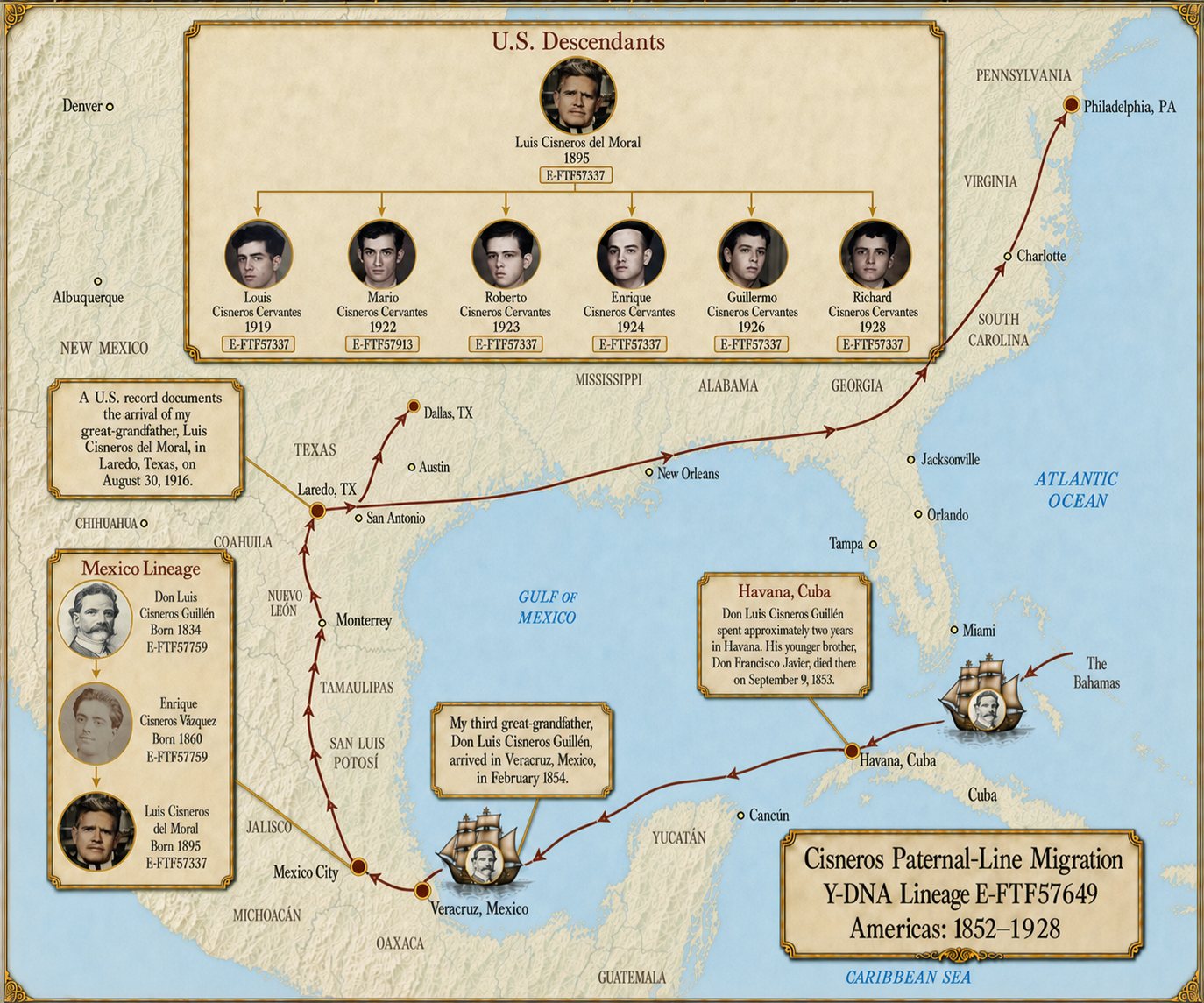
The line moved in two great phases, each under a different sky:
| 1852–1854 | First Atlantic phase. Seville to Cádiz to Havana to Veracruz to Mexico City, in the age of sail and military revolution. |
| from 1916 | North American phase. Mexico City to northern Mexico to Laredo, then Texas and beyond, during the Mexican Revolution and the First World War. |
The surname stayed the same. The historical landscape changed entirely.
The deeper paternal history
The documented nineteenth-century migration begins in Seville, but the paternal line reaches further north into Castile. Recent research by a Sevillian genealogist, working through the Archivo Arzobispal de Sevilla and the parish books of Villanueva de los Infantes, now supplies an indirect but tangible bridge from this branch into Ciudad Real. A capellanía founded at the Iglesia de San Andrés de Sevilla by Don José León Cisneros, a Sevillian merchant in the Carrera de Indias, names Villanueva de los Infantes in Ciudad Real as the town of his maternal grandfather, Don Francisco Cisneros Alfaro; the parish books there record Cisneros-Alfaro marriages in 1588 and 1595.
The connection reaches this line indirectly, through José León rather than through Don Jorge himself, and the finer chain between the two remains work for the archive. But it converts a question that used to have only a genetic answer into one that also has a paper one.
Y-DNA adds a dimension paper cannot. Modern paternal descendants of this family fall within the Y-DNA lineage E-FTF57649 and its downstream branches. Testing also shows a genetic relationship with Cisneros men whose paternal ancestors remained for centuries in the town of Cisneros, Palencia, with a common paternal ancestor estimated around five hundred years ago.
That does not supply the name of the shared ancestor, nor the documentary path by which one branch moved from Palencia toward Ciudad Real and Seville. Genetics cannot replace missing parish, notarial, and court records. The registry of earliest known ancestors lists every tested Cisneros line and the ancestor that anchors it. What it can do is establish that the relationship rests on more than a shared surname, which matters enormously for a name like this one. As the Cisneros Y-DNA study shows, Cisneros is a place name that unrelated families adopted independently, so shared spelling proves nothing on its own. Here, the chromosome and the paper trail agree.
The documents reconstruct the visible migration of identifiable people. The Y chromosome preserves the deeper continuity running beneath it.
What is proven, and what is not
A responsible reconstruction has to separate evidence from interpretation. Here is the ledger as it currently stands.
- Don Jorge de Cisneros y Durán Sotomayor married four times; his fourth marriage to María Antonia Guillén produced Jorge, Luis, Concepción, and Francisco Javier.
- Luis was born in Seville on February 20, 1834 and baptized the next day at the parish of San Esteban; the entry names his grandparents, Vicente Cisneros and Josefa Durán y Sotomayor of Seville, and Tomás Guillén and María del Rosario Montero of Osuna.
- His death generated an extensive probate proceeding involving his heirs.
- Luis and Francisco Javier sailed aboard the Paquete Gaditano from Cádiz, arriving in Havana on February 21, 1852 after twenty-nine days.
- Francisco Javier died in the Monserrate parish district of Havana on September 9, 1853.
- In February 1859 María Antonia Guillén was resident at Ciudadela de Menorca, where she settled Francisco Javier's estate and empowered her son Jorge to act for the family.
- Luis arrived at Veracruz aboard the Martín on February 7, 1854, and was listed at the Hotel de la Bella Unión in Mexico City on February 28, 1854.
- A contemporary ecclesiastical record described him as Spanish and military, and referred to his travels through the Republic for his military career.
- He married Benita Vázquez; their son Enrique Cisneros Vázquez was born in Mexico City in 1860; Luis died in 1861.
- The line continued through Enrique and Luis Cisneros del Moral.
- Luis Cisneros del Moral entered the United States at Laredo on August 30, 1916, and died in Chicago in June 1989; a Mexico City obituary remembered him as one of the last Zapatista veterans and recorded his wish to be buried in Morelos.
- That conflict in Don Jorge's probate contributed to the younger brothers' departure.
- That Luis entered military service before reaching Mexico, or shortly after arriving.
- That Francisco Javier's death influenced Luis's decision to leave Havana.
- That Luis's military movements connected with the Revolution of Ayutla or the War of Reform.
- That Luis Cisneros del Moral's revolutionary service in Morelos preceded his August 1916 crossing, which would place it between his sixteenth and twenty-first years.
- What precise dispute occurred between the fourth-marriage children and their older half-siblings?
- Why did the brothers choose Havana, and what did they do there?
- What caused Francisco Javier's death?
- What unit did Luis serve in, at what rank, and on which side?
- In which Morelos battles Luis Cisneros del Moral fought, when his service began and ended, and whether Julio María Cervantes, named in his obituary as his father-in-law and a constitucionalista of 1857, can be verified in the historical record.
These gaps are not weaknesses to be concealed. They define the next stage of the research.
Conclusion
The migration of this Cisneros paternal line did not begin with a romantic departure toward the New World. It began with the death of Don Jorge de Cisneros y Durán Sotomayor and the fragmentation of a household built on four marriages. His younger children inherited a distinguished surname and a professional legacy, and also the legal and emotional consequences of a complicated estate.
In January 1852 two brothers left Cádiz. Twenty-nine days later they reached Havana. One of them died there. The other sailed on to Veracruz, reached Mexico City on the eve of a revolution, was recorded as Spanish and military, married, fathered a son, and died at twenty-seven, fewer than ten years after stepping ashore in the Americas.
The line he founded endured.
The journey crossed an ocean, but it began inside a family.
Sources and documentary foundation
- Portrait and inscription of Don Jorge de Cisneros y Durán Sotomayor, Real Academia de Medicina y Cirugía de Sevilla.
- Parroquia de San Esteban, Seville, baptismal register, 1834, folio 238, entry 699: baptism of Luis Gonzaga Eleuterio Francisco Javier de la Concepción Cisneros Guillén, celebrated February 21, 1834, born February 20; legitimate son of Lic. Jorge Cisneros, native of Seville, and María Antonia Guillén, native of the villa de Osuna; paternal grandparents Vicente Cisneros and Josefa Durán y Sotomayor, of Seville; maternal grandparents Tomás Guillén and María del Rosario Montero, of Osuna.
- Probate proceedings of Don Jorge de Cisneros y Durán Sotomayor, over one hundred pages, under continued review and transcription.
- La Gaceta de La Habana, Havana, February 21, 1852, “Parte Mercantil”, Puerto de la Habana: arrival of the Spanish vessel Paquete Gaditano from Cádiz, Captain Goyeneche, twenty-nine days at sea, 160 tons, cargo consigned to D. J. de la Portilla, 28 passengers.
- Diario de la Marina, Havana, February 22, 1852, “Pasageros llegados”: passenger arrivals for the corbeta Paquete Gaditano, naming D. Francisco Javier Cisneros and D. Luis Cisneros.
- Protocols notarials, Maó, Menorca, Illes Balears, Spain, notarial records 1858–1859, volume ES_AHM_P-1174, archival reference P-1174: instrument executed at Ciudadela de Menorca, February 26, 1859, in which María Antonia Guillén, widow of Don Jorge Cisneros and native of Osuna, acting for herself, as heir of her late son Francisco Javier Cisneros y Guillén (died in the district of the Parroquia de Monserrate, Havana, September 9, 1853), and as guardian of her son Luis, grants power of attorney to her absent son Don Jorge Cisneros y Guillén. FamilySearch, image group number 118781967, image 457 of 818.
- El Universal, Mexico City, February 21, 1854, page 2, “Pasajeros”: arrival at Veracruz from Havana on February 7 aboard the Spanish brig Martín, listing Luis G. de Cisneros. Consulted via NewspaperArchive.
- El Universal, Mexico City, March 1, 1854, page 3, “Movimiento de la población”: guest list of the Hotel de la Bella Unión, calle de la Palma núm. 2, dated February 28, 1854, listing D. Luis Gonzaga de Cisneros. Consulted via NewspaperArchive.
- Ecclesiastical marriage record of Don Luis Gonzaga Cisneros and Doña Benita Vázquez, May 7, 1859, Arquidiócesis de México (Centro), Distrito Federal: Matrimonios 1856–1860, entry 10, page 175, Parroquias Católicas, Distrito Federal. The accompanying proceeding describes him as “español y militar”. “México, Distrito Federal, registros parroquiales y diocesanos, 1514–1970”, FamilySearch, ark:/61903/1:1:6DLH-3HNW.
- Baptismal entry no. 436, Parroquia de Señor San José de México (today San José y Nuestra Señora del Sagrado Corazón, Cuauhtémoc, Mexico City), July 1860, for Jorge Enrique, son of Luis Gonzaga Cisneros y Guillén and Benita Vázquez y Gallardo; indexed in “México, Distrito Federal, registros parroquiales y diocesanos, 1514–1970”, FamilySearch.
- Mexico City power of attorney, 1860, identifying Don Luis Gonzaga Cisneros y Guillén as a Spanish citizen from Seville and naming his brother Don Jorge Cisneros y Guillén.
- Baptismal entry no. 532, March 8, 1895, for Vicente Luis Cisneros, son of Enrique Cisneros and Celsa del Moral, parish of San José y Nuestra Señora del Sagrado Corazón, Cuauhtémoc, Mexico City, volume 65, page 112; “México, Distrito Federal, registros parroquiales y diocesanos, 1514–1970”, FamilySearch, ark:/61903/1:1:QKZF-LYLF.
- “Murió uno de los últimos veteranos zapatistas”, press obituary of Luis Cisneros del Moral, Mexico City press clipping annotated by hand as Excélsior, June 14, 1989, family collection.
- Interpretive genealogical note on the Sevillian Cisneros branch, unpublished, provided by the family. Cites the capellanía founded by Don José León Cisneros at the Iglesia de San Andrés de Sevilla (Archivo Arzobispal de Sevilla, Capellanías, signatura 03252) and the marriage register of the Iglesia de San Andrés, Villanueva de los Infantes (Ciudad Real), for the years 1588 and 1595 (FamilySearch film 004051911). Supplementary detail on the founder from Francisco Andújar Castillo (p. 101), Enriqueta Vila Vilar, Una amplia nómina de los hombres del comercio sevillano del siglo XVII (Escuela de Estudios Hispano-Americanos de Sevilla), and the Índice del Ramo de Reales Cédulas of the Universidad del Rosario (p. 623).
- Ship illustration: generative artwork produced for this article. It is an impression of a vessel of the period, not a historical depiction; no contemporary image of the Paquete Gaditano is known.
- Y-DNA results and comparative paternal-line research, Cisneros Surname Project.
- Real Academia de Medicina y Cirugía de Sevilla, institutional history: chartered as the Regia Sociedad in 1701, transformed by royal order of August 28, 1830.
About this account
This article was researched and written by Mario E. Cisneros, who founded and maintains The Cisneros Project and serves as a volunteer administrator of the Cisneros Surname Project at FamilyTreeDNA. Luis Gonzaga Cisneros y Guillén, whose crossing this article follows, was his third great-grandfather, and the paternal line described here is his own. More about the project and its founder is on the about page.
Do you descend from this line?
If your Cisneros ancestors passed through Seville, Cádiz, Havana, Veracruz, or Mexico City, your records may connect to this one. Parish registers, notarial protocols, passenger lists, and military files all help, and a Y-DNA test can confirm whether your paternal line and this one share an ancestor. If you have documents, photographs, or family memory touching any stage of this route, please write. Every added record sharpens the picture. You may also find the frequently asked questions useful if you are new to surname studies.
Add your branch to the study and find out where your paternal line fits.
Join the Cisneros Surname ProjectAdd to the record
Do you have a correction, a document, or a family memory that touches this story? Contributions are read personally and are not published automatically. Those that add to the record are published on this page, credited as you wish.